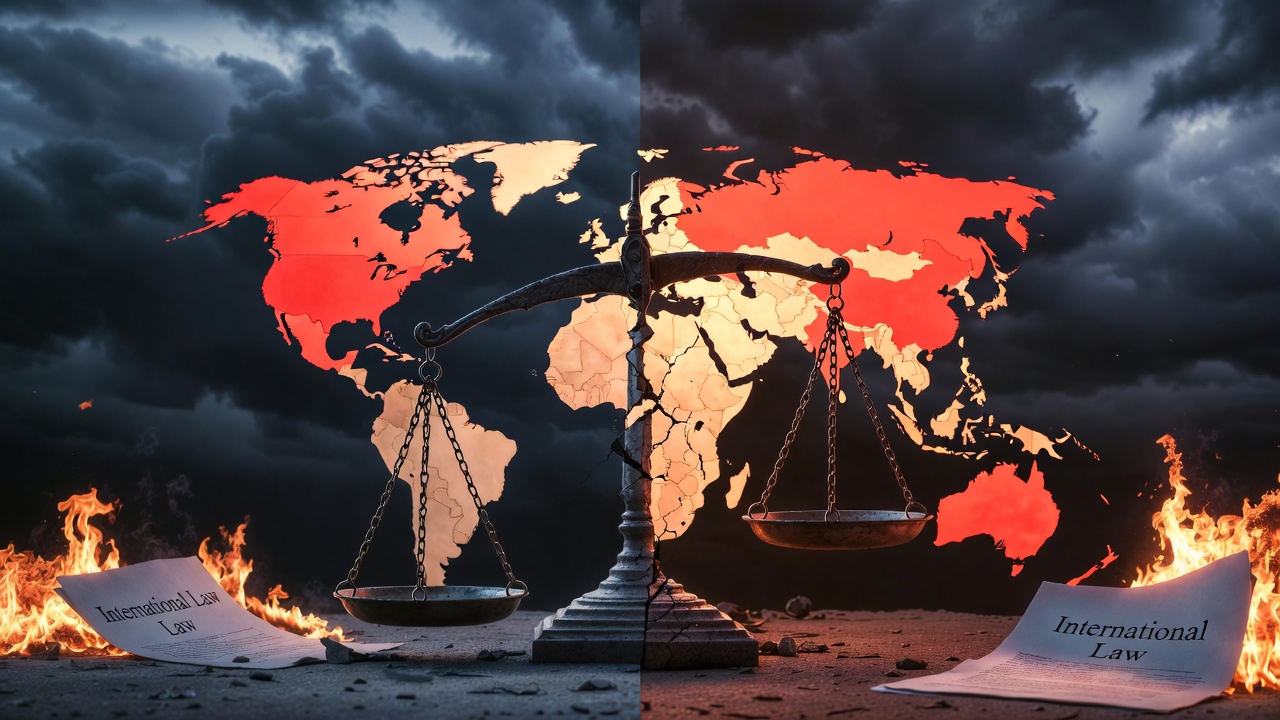
The Alarming Crisis: How International Law and Rule of Law Are Being Undermined from Gaza to Greenland
Introduction: The Universal Nature of International Law
International law and rule of law are facing an unprecedented crisis in 2026. The principles that have governed international relations for decades are being systematically dismantled by powerful nations, from Gaza to Greenland, creating a dangerous precedent that threatens democracy worldwide.
The concept is fundamentally simple: just as human rights apply to all people, international law applies to all states—from Gaza to Greenland, from Iran to Venezuela, Ukraine, Sudan, and Syria. Before the law, both states and individuals are equal. This universal application of international law forms the bedrock of global justice and peaceful coexistence.
The Fundamental Principle: Equality Before the Law
International law and rule of law establish that no ruler may forcibly remove another ruler from power, regardless of personal opinions about leaders like Ayatollah Khamenei, Donald Trump, Nicolás Maduro, Vladimir Putin, or Benjamin Netanyahu. While many may wish to see these individuals face international courts, the rule of law must be applied consistently.
Every human being has an equal right to life, regardless of their beliefs, birthplace, or current location—whether on a rubber boat in the Mediterranean Sea, on occupied territory, or in a prison anywhere in the world. This fundamental principle of international law protects the most vulnerable and ensures that power cannot override justice.
Germany’s Dangerous Shift Away from International Law
In Germany, these principles of international law and rule of law are no longer taken for granted. International law is increasingly dismissed with mockery, and what is written in legal codes doesn’t apply equally to everyone in practice. This represents a fundamental shift in Germany’s relationship with legal principles that were established after World War II.
The erosion of international law in Germany reflects a broader global trend where powerful nations selectively apply legal standards based on political convenience rather than universal principles.
The Connection Between Foreign and Domestic Policy
Most people have not yet grasped the crucial connection between foreign and domestic policy when it comes to international law and rule of law: whoever disregards humanitarian international law will also undermine their own constitution. The principle behind both is the same: the rule of law versus arbitrary power.
The opposite of rule of law is arbitrariness, and this manifests both externally and internally. This pattern can be observed in real-time in two countries that Germany considers close partners: the United States and Israel. Both nations demonstrate how violations of international law abroad inevitably lead to the erosion of democratic principles at home.
Case Studies: USA and Israel’s Descent into Arbitrary Rule
The United States: From Democracy to Authoritarianism
The same US leadership that kidnaps Maduro and claims Greenland also arrests, deports, and shoots people in the streets. This blatant disregard for international law has domestic consequences that threaten the rule of law within America itself.
The United States has withdrawn from 66 international bodies and conventions, signaling a comprehensive rejection of the international legal order. This withdrawal undermines international law and demonstrates how powerful nations believe they are above global legal standards.
Israel: Occupation and Internal Oppression
Israel’s government assassinates its enemies abroad, occupies and annexes territories of other peoples and states, and persecutes critics at home more aggressively than ever. Courts, intelligence services, security forces, and media are being employed to maintain power rather than uphold international law and rule of law.
Israel has revoked licenses from 37 humanitarian NGOs, including Doctors Without Borders and Caritas. Germany’s “premium partner” for cybersecurity and military technology is thus declaring humanitarian organizations as enemies, further demonstrating the breakdown of international law.
The Pattern: International Violations Lead to Domestic Erosion
Constitutional judges and central bank chiefs are targeted domestically, while judges at the International Criminal Court and UN representatives are attacked internationally. National NGOs are targeted alongside worldwide aid organizations and UN agencies. The pattern is always the same: those who override international law internationally will eventually do the same in their own country, as demonstrated in both US and Israeli policies.
This erosion of international law and rule of law follows a predictable trajectory. When governments normalize violations of international legal standards abroad, they inevitably apply the same arbitrary methods domestically, undermining constitutional protections and democratic institutions.
Democracy Doesn’t Prevent Fascism
Both Trump and Netanyahu are democratically elected. They may not take international law seriously, but aren’t they brothers in spirit fighting evil for us? Wrong. What matters is not the legitimization of this policy, but the underlying supremacist worldview: “We alone know what’s good for us, we take what we need, and do what we want.”
These politicians are not about freedom but about subjugation. They want to make their countries “great again” or transform them into a “Super-Sparta.” As history has shown, democracy does not protect against fascism—especially when international law and rule of law are systematically undermined.
The supremacist ideology that justifies violations of international law abroad inevitably targets minorities and dissidents at home. This is not about security or self-defense; it’s about establishing hierarchies of human worth that contradict fundamental principles of international law.
Germany’s Complicity in Violating International Law
This transformation has begun in Germany too, without the AfD in power. The Chancellor finds Maduro’s kidnapping “complex” under international law and thanks Netanyahu for the “dirty work” that Israel supposedly does for Germany. This rhetoric represents a dangerous abandonment of Germany’s commitment to international law and rule of law.
Citizens who take the constitution seriously and therefore demand compliance with international law everywhere are now considered “left,” “woke,” or “progressive.” Some are even labeled as antisemites or extremists, when in fact they are the ones defending the universal lessons from the Holocaust by practicing the fight against anti-Jewish hatred, Islamophobia, and anti-Palestinian racism as a common effort.
Those who want to protect Jewish life in Germany through arms deliveries to Israel have fallen for the propaganda of Israeli ethno-nationalists. True commitment to international law and rule of law requires consistent application of legal principles, not selective enforcement based on political allegiances.
The Fight for Rule of Law: A Universal Struggle
International law and rule of law are not leftist projects but belong to the DNA of Germany and other democratic nations. The principles of international law emerged from the ashes of World War II as a universal commitment to prevent future atrocities and establish a just global order.
The defense of international law is not about politics—it’s about maintaining the legal framework that protects everyone. When we allow violations of international law in one context, we undermine the entire system of rule of law that protects human rights everywhere, as seen in the pattern of violations.
What Citizens Must Do to Protect Rule of Law
Those who want this to remain must seek different international partners and speak up domestically when:
- Cultural centers are closed without due process
- Candidates for the Federal Constitutional Court are falsely accused
- Journalists are defamed or illegally sanctioned
- Berlin police officers beat demonstrators wearing keffiyehs
- Political parties place associations under general suspicion
- Intelligence services are supposed to decide on funding for science and education
Each of these actions represents a violation of rule of law principles. Citizens committed to international law and rule of law must challenge these violations consistently, both domestically and in foreign policy.
Protecting international law and rule of law requires:
- Active civic engagement – Speaking out against violations wherever they occur
- Consistent application – Demanding the same legal standards for all nations
- Supporting independent institutions – Defending courts, journalists, and NGOs
- International solidarity – Building connections with human rights defenders globally
- Education and awareness – Understanding the connection between international and domestic law
Conclusion: Defending Legal Principles in Critical Times
The crisis of international law and rule of law in 2026 represents one of the most significant threats to global peace and human rights since World War II. From Gaza to Greenland, powerful nations are abandoning legal principles in favor of arbitrary power, creating a dangerous precedent that undermines democracy worldwide.
The connection between violations of international law abroad and the erosion of constitutional protections at home is undeniable. Germany, the United States, and Israel are demonstrating how quickly the rule of law can be dismantled when political convenience overrides legal principles.
However, international law and rule of law are not abstract concepts—they represent concrete protections for human rights and dignity. Defending these principles requires constant vigilance, consistent application, and the courage to challenge powerful interests, as outlined in what citizens must do.
The fight for international law and rule of law is ultimately a fight for human dignity and justice. Those who compromise these principles in one context will inevitably compromise them everywhere. The universal application of international law is not idealistic—it is the only foundation for a just and peaceful world.
As citizens of democracies, we must demand that our governments uphold international law consistently, from Gaza to Greenland and everywhere in between. The rule of law is not negotiable, and its defense is the responsibility of every person who values justice, equality, and human rights.
About the Author
Kristin Helberg is a journalist and political scientist. She reported for many years from Damascus, has written several books on Syria, and works as an author, Middle East expert, and moderator in Berlin. Her expertise in international law and Middle Eastern politics provides crucial insights into the current crisis of the global legal order.
Related Resources
- United Nations Office of Legal Affairs
- International Court of Justice
- Human Rights Watch – International Justice
- Amnesty International – International Law
Visit TEJ365 For more.
Catch up with what happening in USA USA News
We’d love to hear from you! Whether you have questions, suggestions, or just want to say hello, feel free to reach out through the following channels: Connect with us
Please Like us & Support us-https://www.facebook.com/profile.php?id=61571327091097